
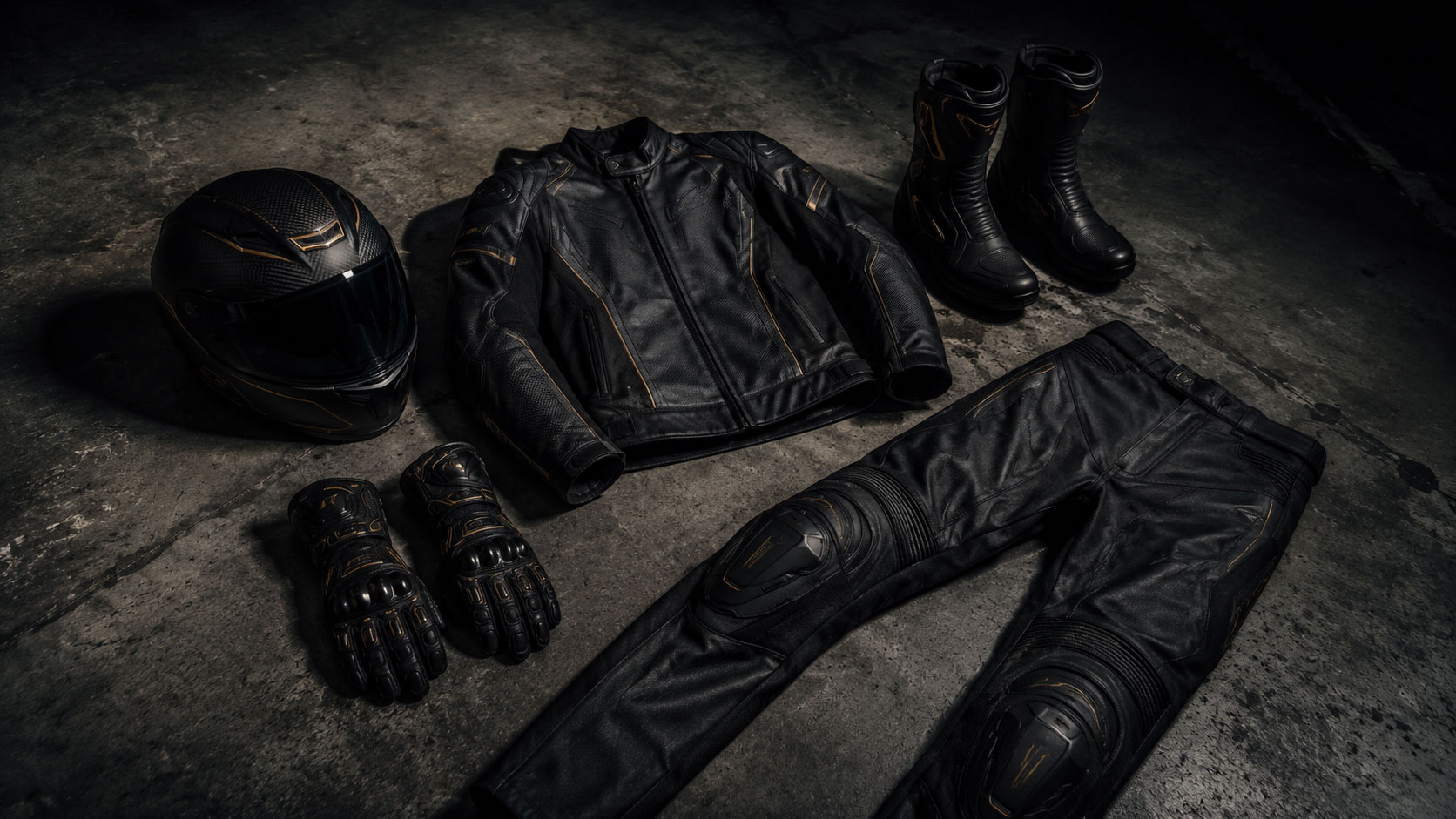
Keeping yourself safe
ATGATT: All The Gear, All The Time
30 June 2026
7 min readYou've heard it said. You might have said it yourself. ATGATT: All The Gear, All The Time. It's a philosophy that divides opinion among riders, but the data — and the experience of riders who've had offs — points in one direction.
The logic is straightforward. You can't choose when you'll crash. An incident on a five-minute run to the shops is no different to one on a motorway in terms of what happens when skin meets tarmac at speed. The road doesn't care that you were 'only popping out.'
What ATGATT actually means
At its core, ATGATT means wearing appropriate protective gear every time you ride — not just on longer rides, not just in bad weather, not just when you're in the mood.
It doesn't mean you have to own the most expensive gear on the market. It means consistently wearing what protection you have, every single time you throw a leg over the bike.
Is it too familiar?
Most crashes happen within 25 miles of home. Your everyday commute isn't low risk — it's just familiar.
The five key areas of protection
Good motorcycle gear is designed to protect five areas of your body that are statistically most at risk in a collision or fall:
Head — your helmet
A helmet is non-negotiable. In the UK it's also a legal requirement. But not all helmets offer the same level of protection. Look for ECE 22.06 certification — the current European standard. SHARP ratings (the UK government's helmet safety scheme) give each helmet a 1–5 star safety score based on independent testing.
A helmet that fits correctly is as important as its certification. A loose helmet can rotate on impact and a too-tight helmet causes fatigue and discomfort that affects your concentration. Get properly fitted in person if you can.
Hands — your gloves
In a fall, your hands are the first thing to hit the ground - it's instinct to reach out and break a fall. Without proper gloves, the result can be deep abrasions, broken bones and nerve damage.
Palm sliders and knuckle protection are not themselves "CE-rated." Only a complete glove, tested and certified as a finished product, can carry a CE mark – individual features or materials cannot. Be wary of any listing that rates a component rather than the finished garment; this is a common tactic used to sell untested, uncertified gloves online.
The standard for motorcycle gloves is EN 13594:2015, which tests gloves for abrasion resistance, tear strength, cut resistance, seam strength and resistance to removal (staying on the hand in a slide), classifying them as Level 1 (lowest level of protection), Level 1 KP (Level 1 with optional knuckle protection added) and Level 2 KP (highest level of protection, with mandatory knuckle protection). Look for the EN 13594 marking on the product and details of the certifying Notified Body number in the accompanying instructions for use, not just a manufacturer's claim.
Torso — your jacket
A decent motorcycle jacket does two things: it resists abrasion as you slide along the road, and it absorbs impact through armour at the shoulders, elbows and back.
Leather can offer excellent abrasion resistance, and modern textile jackets with D3O or similar armour can be equally effective and more versatile for UK weather – but the presence of a certified impact protector says nothing about the jacket itself. Rogue vendors routinely fit a certified back or shoulder protector into a jacket that has never been tested to any clothing standard, then market the whole garment as though it were certified.
The standard for motorcycle clothing - jackets, and jacket/trouser combinations - is EN 17092:2020. It tests the garment as a whole for abrasion resistance, tear strength, seam strength and burst strength, and requires impact protectors to meet EN 1621-1 for limb protectors or EN 1621-2 for back protectors. Garments are classified AAA (highest protection, requiring fitted shoulder, elbow, hip and knee protectors), AA (mid-range, with the same impact protector requirements as AAA), and A (lowest performance requirements, more suited to urban/short-journey use, fitted with shoulder, elbow and knee protectors, with hip protectors not required). There is also B classification for garments without fitted protectors, and finally C classification for specialist garments designed to incorporate at least one item of impact protection. Look for the EN 17092 class marked on the garment's label, not just an armour brand name on the hangtag, and check that the statutory instructions for use are present.
Legs — your trousers
Motorcycle trousers are probably the most commonly skipped item. Jeans feel protective, but ordinary denim offers very little abrasion resistance compared with purpose-built riding trousers with armour built in at the hips and knees.
As with jackets, riding trousers are certified as a complete garment under EN 17092:2020, using the same AAA/AA/A/B/C classification described above. A trouser or jacket-and-trouser combination should carry that marking; a hip or knee protector's own certification (EN 1621-1) does not extend to the garment it sits in.
Fitting certified armour inside ordinary clothing is better than nothing, but it does not turn that clothing into motorcycle trousers. Regular fabric, seams and thread are not specified for motorcycle use, and can tear or burst open at the first contact with the road - at which point the armour itself is likely to be dislodged or lost. Where full riding trousers aren't worn, armoured under-layers should be treated as a supplement to abrasion-resistant outerwear, not a substitute for it.
Feet — your boots
Your feet and ankles are vulnerable in a crash. Standard trainers or shoes offer no ankle support and virtually no abrasion resistance. Motorcycle boots with ankle reinforcement and sole grip can mean the difference between a twisted ankle and a serious injury. You don't need to wear full motocross boots for a commute - there are motorcycle boots that look like regular footwear but still provide genuine protection.
The standard for motorcycle footwear is EN 13634:2017, which groups boots by height into two categories – 1 for lower boots and 2 for higher boots – and tests abrasion resistance, impact cut resistance and transverse rigidity (resistance to sideways crushing of the sole, which protects against the boot being crushed between machine and road surface), each rated to performance Level 1 or Level 2. Optional testing covers impact protection at the ankle and shin, plus other features such as water penetration resistance. As with gloves and clothing, look for the EN 13634 marking on the boot itself rather than relying on appearance or a general description of "motorcycle boots." As with gloves and clothing, look for the EN 13634 marking on the boot itself rather than relying on appearance or a general description of "motorcycle boots", and check that the statutory instructions for use are present.
A general point on buying online
Riders buying in a shop or at a motorcycle show can generally rely on what's in front of them having been tested and certified, and can ask staff directly. Buying online removes that reassurance, so it's worth taking a few extra steps before paying: check the listing or product page for the specific EN standard and class (AAA/AA/A for clothing, Level 1/2 for gloves), look for the CE mark in the product photos, and be cautious of unfamiliar brands relying on vague terms like "CE-rated" or "impact protection" without naming a standard at all.
Genuine certified gear is required to include the manufacturer’s name and address on the marking, and to be accompanied by instructions for use so you can check where the product was tested and certified. Organisations such as MotoCAP publish independent test results for a growing range of clothing on the market. If in doubt, buying from an established motorcycle retailer, in person or online, remains the simplest way to be sure of what you're getting.
Gear check checklist
Before every ride, ask yourself:
Helmet on, fastened correctly
chin strap secure, visor clean
Gloves on
CE-rated with palm and knuckle protection
Jacket on
armour in place, zips done up
Riding trousers or armoured underlayer
not just jeans
Boots
ankle support, not trainers or flip flops
Riding with an expired or damaged helmet
helmets degrade over time even without impacts
Skipping gloves on short journeys
most hand injuries happen close to home
Wearing a jacket but leaving it unzipped
it won't stay on in a slide
Back protector not yet CE Level 2 rated
consider upgrading
Gear more than 5 years old
worth reviewing condition and ratings
The comfort argument
The most common reason riders skip gear is comfort — especially in warmer weather. It's understandable. Wearing a full jacket in summer heat is unpleasant.
But the gear industry has responded. Modern mesh jackets provide airflow while still providing armour. Lightweight textile options exist that are far cooler than leathers. The barrier between protection and comfort is lower than it's ever been.
And if comfort really is the barrier, ask yourself this: how comfortable is a skin graft?
The One Split Second take
You cannot predict when you'll need your gear. You can only decide whether you'll be wearing it when that moment arrives.
Ride Safe.
Make the decision
Every ride is a decision. All The Gear, All The Time isn't a rule imposed on you. it's a choice you make for yourself, and for the people who want you to come home.
We want your rider stories to help others learn.
Drop us an Email at:
With kind thanks to:
Paul Varnsverry of PVA-PPE GROUP for your input and correcting and re-writing the five key areas of protection information and adding the general point on buying online.