
ROAD SAFETY POLICY & RIDER ADVOCACY
Beyond the Saddle: Can More Be Done to Keep UK Riders Safe?
15 August 2026
5 min readEvery motorcyclist knows the feeling. You click into first gear, roll on the throttle, and take in the unique rhythm of the open road. But ask any UK rider about their daily journey, and you’ll hear a familiar story: sharp observations, sudden near-misses, and the constant mental bandwidth needed to stay safe.
The numbers tell a stark story. Motorcyclists account for less than 1% of total traffic on Great Britain’s roads, yet consistently represent over 20% of all road fatalities. Per mile travelled, a rider is roughly 40 times more likely to be killed or seriously injured than a car driver.
At One Split Second, we focus on building sharper habits and making calmer choices in the saddle because one split second changes everything. But rider roadcraft is only one part of the puzzle. Is enough being done across driver education, motorcycle training, and government policy to protect us on the road?
1. Changing How Drivers Are Taught: Tackling "Looked-But-Failed-To-See"
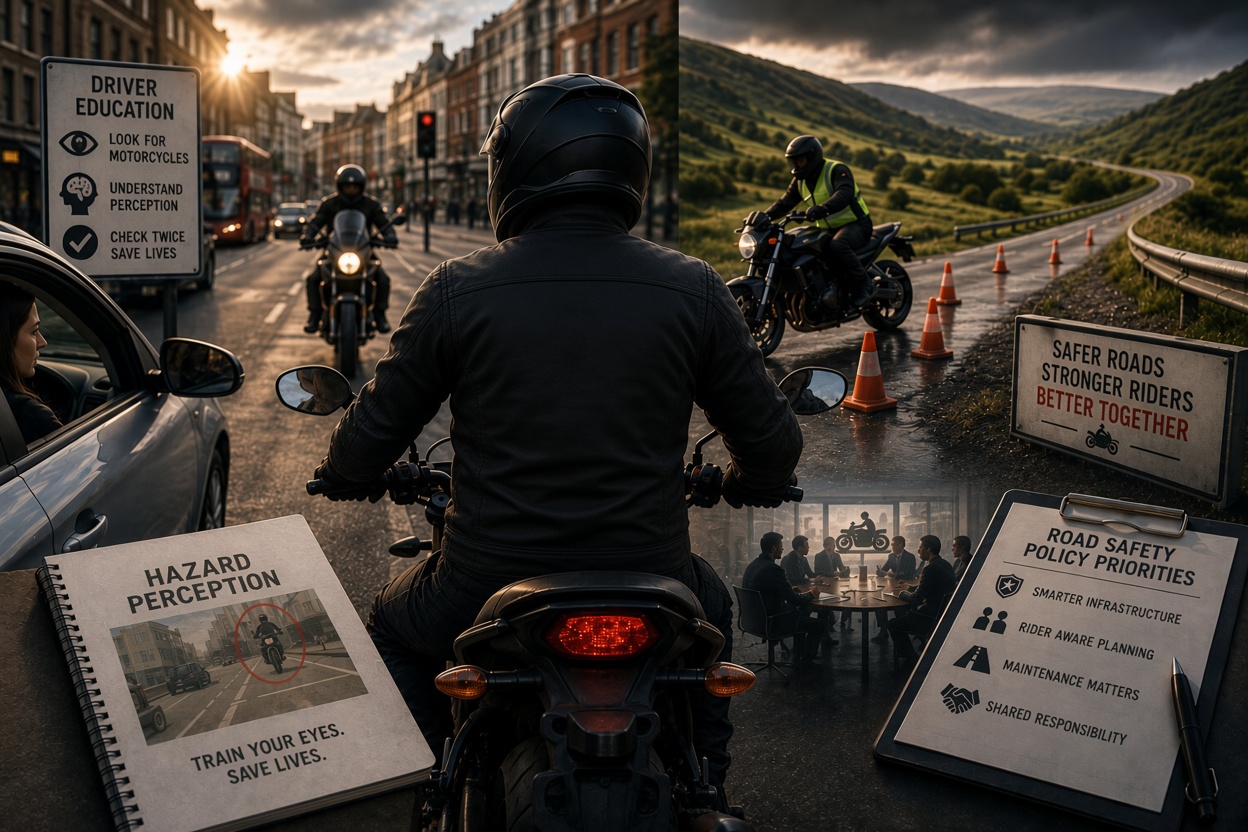
Ask almost any rider who has been involved in an urban junction incident, and they'll tell you the driver’s response: "I just didn't see you." Ineffective driver observation remains the leading contributing factor in serious multi-vehicle collisions involving motorcyclists. Yet, standard driver training in the UK still treats motorcycles as a footnote. Learner drivers are taught to look for cars and lorries, but they are rarely taught how the human brain processes visual information.
Understanding Saccadic Masking:
As mentioned in a previous post, the human brain takes shortcuts. When a driver glances quickly left and right at a junction, their eyes perform rapid jumps (saccades). If a narrow object like a motorcycle sits inside one of those visual gaps, the driver’s brain literally fills in the background, making the rider invisible.
What Needs to Change:
Driver instruction must evolve. Mandatory hazard perception and practical driving tests should explicitly train learners to spot two-wheelers, teaching drivers to perform deliberate, two-stage checks at junctions and to check mirrors for filtering traffic before opening doors or changing lanes.
If we want to reduce junction collisions, we need driver education that actively trains motorists to look for riders, not just around them.
2. Modernising Motorcycle Training: Moving Away from "Permanent Learners"
Motorcycle training itself needs a rethink. The UK’s current Compulsory Basic Training (CBT) and licensing structure was established decades ago, and the government’s 2026 Road Safety Strategy consultation has highlighted where the system falls short.
Right now, a rider can take a single-day CBT course at 16 or 17 and continually renew it every two years without ever taking a theory test or undergoing further formal instruction.
Mandatory Motorcycle Theory Tests:
Introducing a motorcycle-specific theory and hazard perception test before (or as part of) taking a CBT ensures new riders understand basic roadcraft and hazard anticipation before mixing with live traffic.
Machine-Specific CBTs:
Completing a CBT on an automatic scooter currently allows riders to jump straight onto a manual 125cc motorcycle with zero additional coaching on clutch control or gear selection. Restricting automatic CBT completions to automatic machines unless an upgrade module is completed is a straightforward, sensible safety measure.
Progressive Access Over Testing Hurdles:
Moving away from endless, costly retakes (Module 1 and Module 2) toward structured, training-based progression (like the Enhanced Rider Scheme or Direct Access upgrades) encourages riders to continuously upskill rather than staying stuck as "permanent learners" on provisional status.
Safety doesn't come from making licensing needlessly complicated or expensive; it comes from continuous, high-quality coaching that builds real-world confidence.
Smarter, Motorcycle-Friendly Infrastructure
3. What the Government Must Do: Infrastructure & Policy
While individual roadcraft is vital, infrastructure and policy failures still leave riders needlessly exposed. The government’s goal to cut road deaths by 65% by 2035 demands structural action, not just awareness campaigns.
The Danger of Steel Guardrails:
Standard roadside steel W-beam barriers are engineered to contain heavy cars and lorries, but they can act as severe hazards for fallen motorcyclists. Upgrading high-risk rural bends with continuous lower protection rails (motorcycle-friendly barriers) dramatically reduces severe impact trauma.
Road Surface Quality:
Gravel on apexes, diesel spills, hidden farm entrances, and unsealed potholes aren't minor inconveniences for riders, they are life-threatening hazards. Priority maintenance schedules for known motorcycle routes can save lives overnight.
Bus Lane Access:
Standardising motorcycle access to bus lanes nationwide gives riders a safe, dedicated space away from heavy, stop-and-go urban traffic.
Integrating Motorcycles into Transport Strategy
For too long, local transport plans have treated motorcycling as an afterthought or lumped it in with general vehicular traffic. Real casualty reduction happens when transport planners, infrastructure engineers, enforcement teams, and rider groups sit around the same table to design safer road spaces.
The One Split Second Take: Power in the Pack
We aren't here to promise that the country's infrastructure will change overnight or that every car driver will suddenly become hyper-aware. But by calling for better driver training, modernised motorcycle coaching, and rider-aware road infrastructure, we push the conversation where it needs to go.
At the end of the day, road safety is a shared responsibility. We will keep sharpening our observations, choosing calmer lines, and looking out for one another in the saddle. But it’s time for driver education and government infrastructure to meet us halfway.
What do you think? Should learner drivers be required to undergo mandatory motorcycle awareness training? Is the CBT system due a refresh, or should infrastructure be the top priority?
Send us your thoughts at the email address below, or hop over to our One Split Second Facebook Community to join the discussion and share your experience!
Ride safe, keep it calm, and look out for the rider behind you. — The One Split Second Team
We want your rider stories to help others learn.
Drop us an email at: