
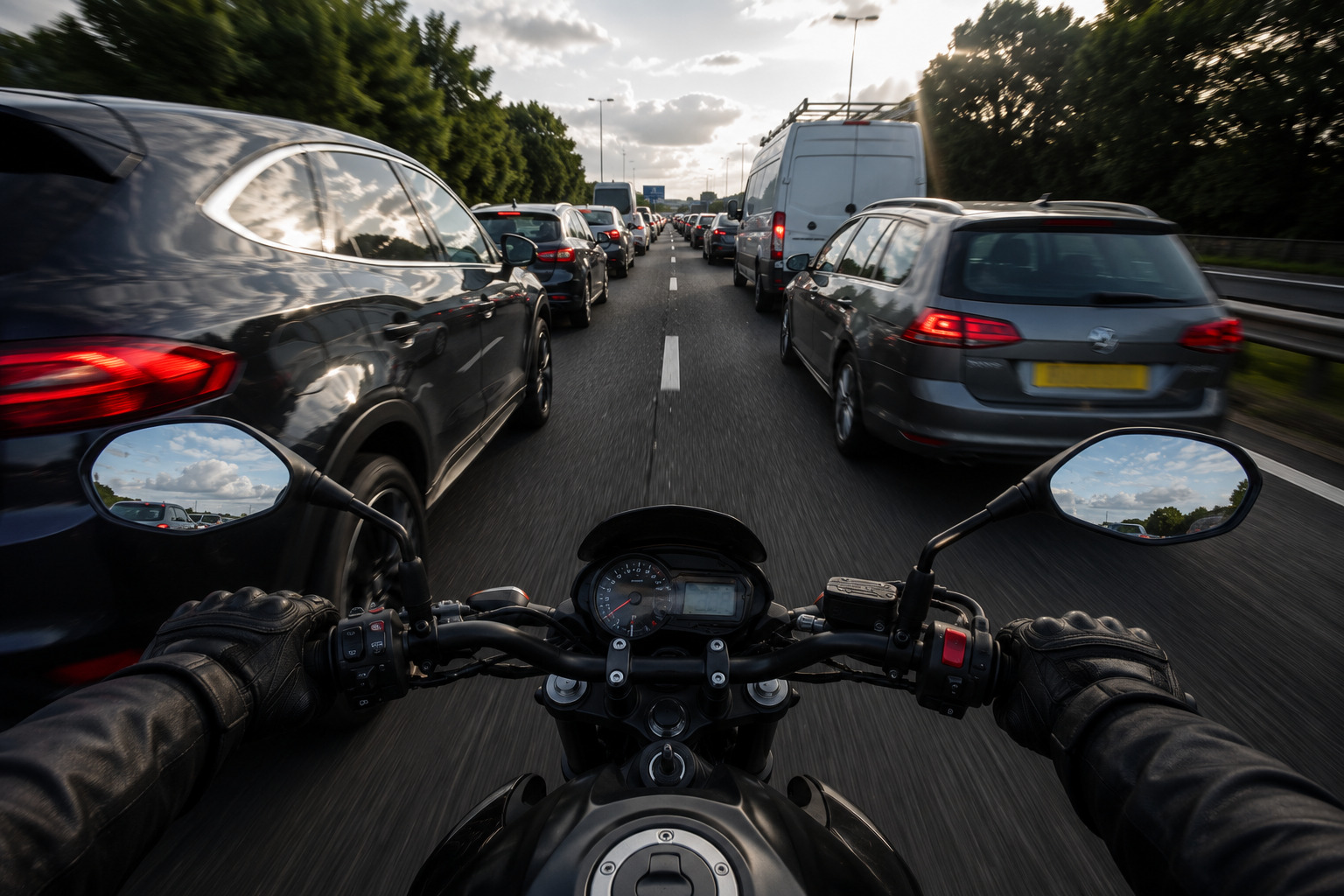
Filtering: One of the Biggest Advantages of Riding – But Also One of the Biggest Risks
9 June 2026
4 min readFiltering is one of the many reasons people choose to ride motorcycles. Whether you're making progress through rush-hour traffic, avoiding long queues, or simply getting home a little quicker, filtering can be a huge advantage over travelling in a car.
In the UK, filtering is legal and widely accepted, but just because it's legal doesn't mean it's without risk.
Many motorcycle collisions occur while filtering, often because a rider or driver fails to see the other until it's too late.
The reality is that filtering safely isn't about how quickly you can get through traffic. It's about reading the road, anticipating mistakes, and giving yourself enough time to react when the unexpected happens.
What Exactly Is Filtering?
Filtering is when a motorcyclist passes slow-moving or stationary traffic by riding between lanes or lines of vehicles.
Done correctly, it can reduce congestion and help riders make safe progress through traffic. However, every vehicle around you represents a potential hazard and as riders, we have to assume that any of these things could happen at any moment.
Change lanes without checking mirrors.
Open a door unexpectedly.
Perform a U-turn.
Pull into a gap in traffic.
Follow another vehicle without properly checking what's coming.
As riders, we have to assume that any of these things could happen at any moment.
The Speed Question
One of the most common questions riders ask is:
"How fast should I filter?"
There is no specific legal speed limit for filtering, but experienced riders and advanced riding organisations generally agree on one principle:
"The faster you filter, the less time you have to react"
Many advanced riders use a rule of keeping their speed only around 10–15 mph faster than the surrounding traffic.
If traffic is stationary, that might mean filtering at around 15-20 mph.
If traffic is moving at 20 mph, you may only need to be travelling at 30-35 mph.
The exact speed isn't as important as your ability to stop safely within the distance you can see to be clear.
If you couldn't stop before hitting a vehicle that suddenly changes direction, you're probably travelling too fast for the situation.
A Common Filtering Scenario
Imagine you're riding home after work.
Traffic has backed up approaching a roundabout and cars are barely moving. You decide to filter carefully between the lanes.
Everything looks clear.
Suddenly you spot a gap between two cars.
Experienced riders immediately become cautious when they see gaps.
Why?
Because gaps attract movement.
A driver may decide to change lanes.
Someone may attempt a U-turn.
Another vehicle may pull out from a side road.
As you approach, a car suddenly moves across the gap without warning.
If you're travelling too quickly, you've got very little time to react.
If you're filtering at a controlled speed and actively looking for hazards, you've given yourself a chance.
That's often the difference between a near miss and a collision.
Who Is At Fault?
One question that regularly comes up is who is responsible if a collision occurs while filtering.
The answer depends on the circumstances.
If a driver changes lanes without checking properly and collides with a filtering motorcycle, responsibility will often fall heavily on the driver.
Likewise, if someone opens a door into the path of a rider without checking, they may be found responsible because road users have a duty to ensure it is safe before opening a vehicle door.
However, riders are not automatically free from blame.
If a motorcyclist is filtering at an excessive speed or riding in a manner that would be considered unsafe, responsibility can sometimes be shared.
This is why riding defensively is so important.
Being legally right doesn't undo injuries or repair damaged bikes.
Reading the Clues
Good filtering is less about riding and more about observation.
Look for clues that tell you what might happen next, the earlier you spot these signs, the more time you have to react.
Front wheels starting to turn.
Drivers looking over their shoulder.
Gaps appearing in traffic.
Junctions and side roads.
Passengers moving inside vehicles.
Brake lights switching off.
Filtering Is a Skill
Filtering is one of the most useful skills a motorcyclist can develop, but it's also one that demands concentration and patience.
There's no prize for being first through the queue.
Every rider has heard stories of someone who was "only making progress" when suddenly a car moved into their path.
Often, the difference comes down to one split second.
One observation.
One decision.
One life saver glance.
One moment that gives you enough time to avoid a collision.
Final Thoughts
Filtering can be safe, efficient, and one of the greatest advantages of riding a motorcycle.
But every time you filter, remember that you're relying on people who may not have seen you.
Keep your speed sensible.
Expect the unexpected.
Watch for the clues and always leave yourself enough time to react.
Because one split second can make all the difference.