
Conspicuity
Is high-vis the answer?
28 August 2026
3 min readHi-vis feels like the easy win. Pull on a fluorescent vest or jacket, and surely you've done the responsible thing — you've made yourself impossible to miss. It's why rider training courses push it, why some riders won't leave the drive without it, and why it's become shorthand for "taking visibility seriously."
But conspicuity isn't really about how bright your kit is. It's about contrast — whether you stand out from whatever's directly behind you, at the exact moment a driver's eyes sweep past. And that's where hi-vis starts to get complicated, especially once the clocks start thinking about going back and the roadsides turn gold.
Why it exists in the first place
The case for hi-vis comes from a real and stubborn problem. "Failed to look properly" is consistently the single biggest contributory factor recorded against both riders and other drivers in fatal and serious motorcycle collisions — 3,412 instances involving motorcyclists between 2018 and 2022, according to the Department for Transport's motorcyclist factsheet. Most of that is the classic SMIDSY moment — a driver pulling out of a junction who genuinely didn't register a bike was there. Anything that makes a rider easier to pick out of a scene is trying to chip away at that number, and that's a good instinct.
Where the theory breaks down
The problem is that fluorescent yellow only works as a signal when it's the odd one out. Research summarised by Science of Being Seen — built from the same conspicuity research that underpins rider training courses like Biker Down — makes the point plainly: effectiveness "may depend on the situation in which the motorcyclist was located." A yellow jacket that pops against a hedgerow can disappear against roadworks barriers, hi-vis-liveried vans, or a line of cyclists in matching kit. In town, especially near building sites, you can end up as one more block of colour in a scene that's already full of them.
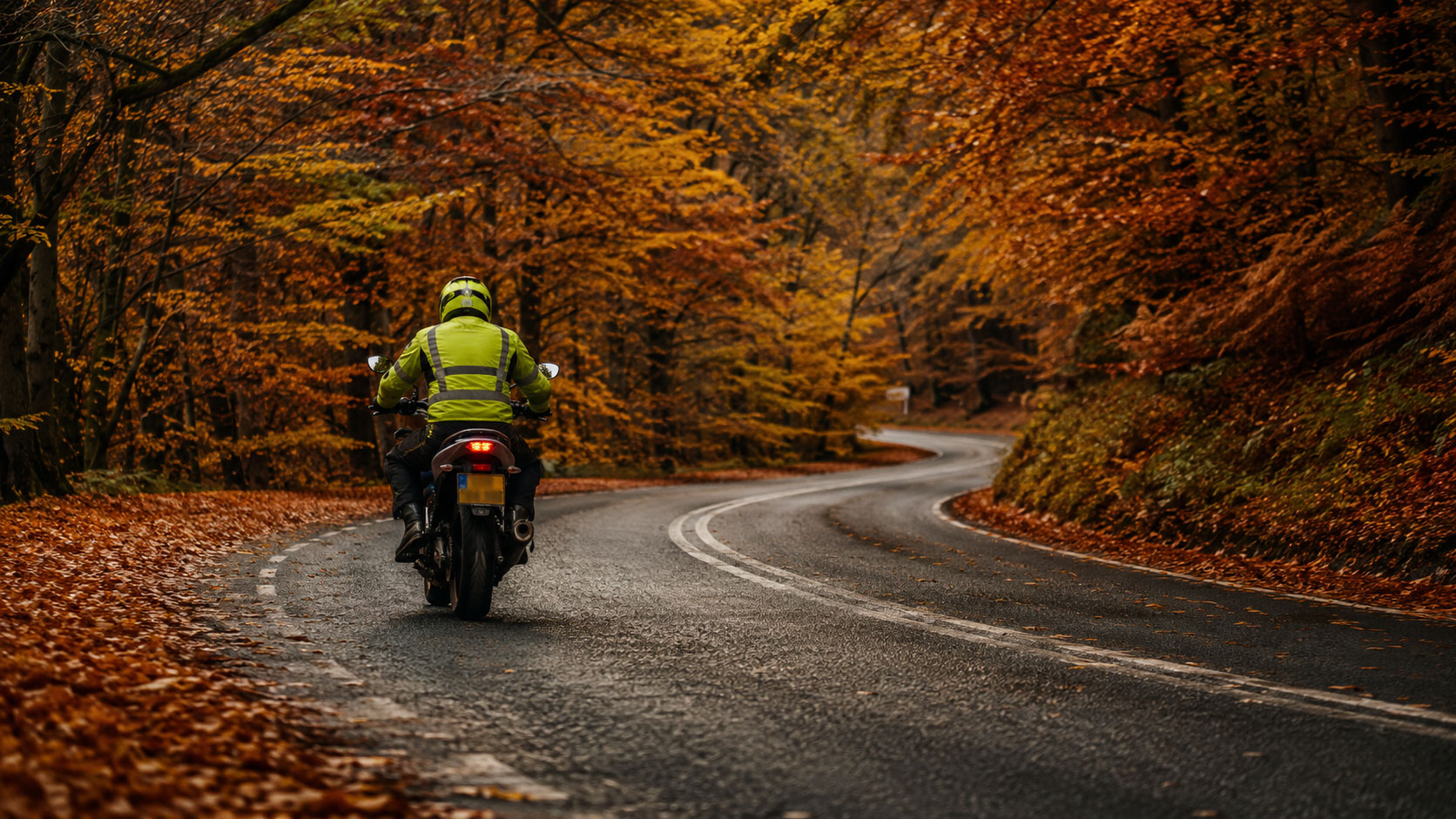
Autumn makes this worse in a specific, seasonal way. As trees turn gold and verges fill with fallen leaves, that same yellow or amber hi-vis can blend straight into the background rather than jumping out of it. You're still glowing — it's just that the hedge is glowing too. Add in low, glaring autumn sun that flattens colour and contrast for the driver looking your way, and a vest that worked perfectly well in July can quietly stop pulling its weight in October.
So is it right or wrong to wear it?
Neither, on its own. Hi-vis is one input into whether a driver clocks you — not a guarantee. Treat it as a tool that needs pairing with the basics that actually put you in a driver's field of view: strong lane position, a headlight that's on and doing something (not just default running lights), and riding in a way that breaks up your silhouette rather than trusting your jacket to do all the work.
Conspicuity isn't a colour you put on — it's a contrast you have to keep checking for, ride by ride, season by season.
The most useful shift is mental, not material: ride every junction as though the driver hasn't seen you, hi-vis or not. That's not pessimism, it's just what the SMIDSY numbers are telling us.
Quick reference
Check what's actually behind you — hi-vis only works when it contrasts with the scene, not just when it's bright
Keep your headlight on and use lane position to break up your outline
Adjust your expectations as the seasons change — what worked in summer light may not in autumn glare
Ride every junction assuming you haven't been seen yet
Treat a hi-vis vest as a forcefield rather than one factor among several
Wear yellow against yellow — roadworks, hi-vis vans, and golden autumn hedgerows all count
Keep the same kit and habits all year without reviewing whether they still work
Think about what's usually behind you on the roads you ride most
Think about whether a driver would actually spot you, or just register "some colour" and move on
Think about pairing gear with riding technique, not swapping one for the other
The One Split Second take
Hi-vis isn't a bad idea — but it's not the whole idea, either. The moment you treat it as a finished answer rather than one part of a bigger picture, you've handed your safety over to a jacket. Autumn is a good time to notice that, because it's exactly when the trick stops working as well as it did all summer.
Ride Safe.
The question was never "hi-vis, yes or no." It's "seen by whom, against what, and for how long."
We want your rider stories to help others learn.
Drop us an email at: