
GEAR & TECH DECODED
Modern Rider Aids: ABS, Traction Control, and the Limits of Physics
30 August 2026
4 min readThere is an ongoing debate at bike meets and cafe stops across the UK: does modern rider technology make us safer, or does it just create lazier, overly confident riders?
Modern motorcycles come stacked with electronic safety suites, from lean-sensitive cornering ABS and traction control to six-axis IMU 'brains' that adjust power delivery in real-time.
At One Split Second, we aren't here to lecture you on tech or tell you that "real bikers don't need electronics". But we do know that while electronic safety nets can be absolute lifesavers, they can never change the laws of physics. Here is how modern rider aids actually work, why relying on them as a crutch is dangerous, and how to use them to keep your riding sharp.
"Electronics can manage your machine's inputs, but they can't create grip out of thin air."
Anti-Lock Braking Systems (ABS) & Cornering ABS
Standard ABS has been around for decades, preventing wheel lock-up during hard or panicked braking by modulating hydraulic pressure when sensors detect a sudden drop in wheel speed.
However, standard ABS was primarily designed for braking in a straight line. Enter Cornering ABS (often tied to a 6-axis Inertial Measurement Unit, or IMU). The IMU constantly measures lean angle, pitch, and roll, adjusting the maximum brake pressure permitted while the bike is leaned over.
The Reality Check:
Cornering ABS allows you to trail-brake or handle emergency inputs mid-bend without instantly tucking the front end. But if you enter a turn vastly over the speed limit for the available radius, no system on earth can stop your tyres from losing lateral traction and washing out into the hedge.
Traction Control Systems (TCS) & Lean-Sensitive TC
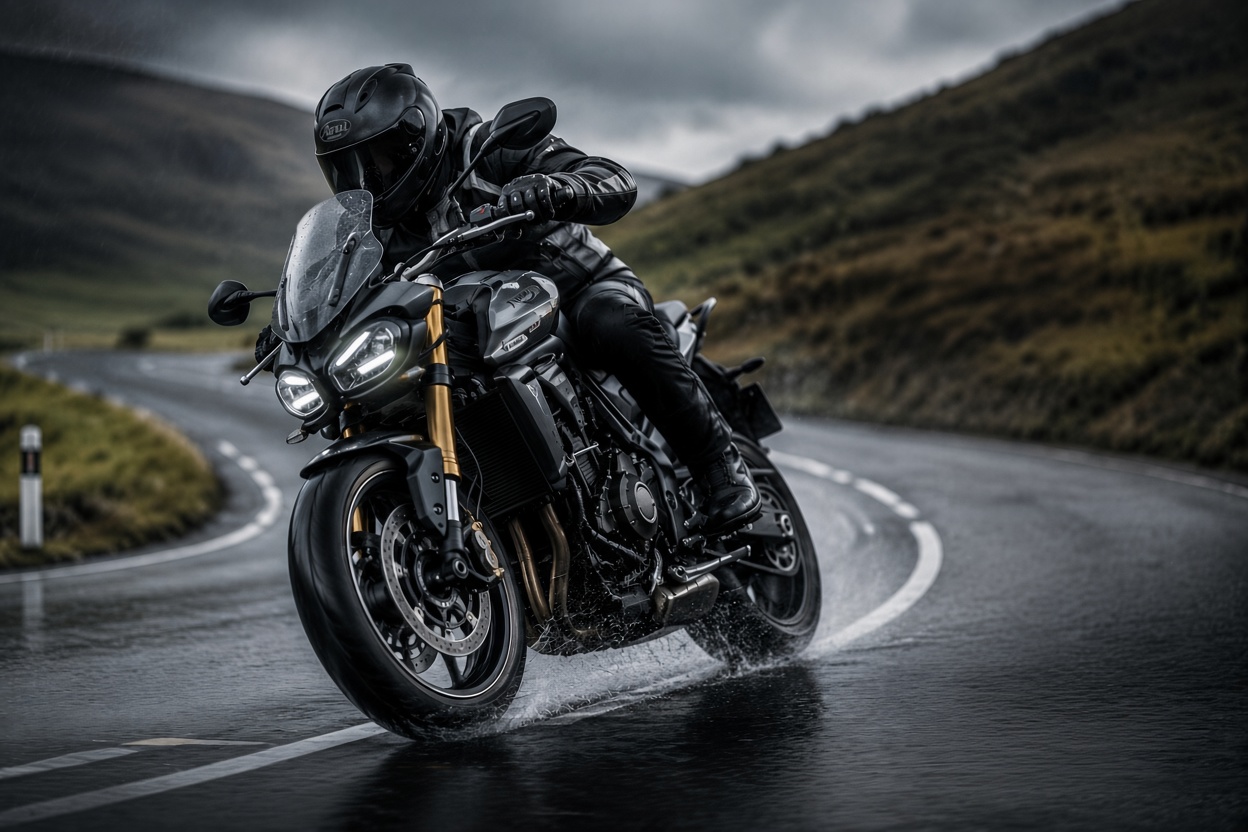
Motorcycle traction control monitors front and rear wheel speeds. If the rear wheel starts spinning faster than the front under acceleration, especially on wet tarmac, diesel slicks, or loose gravel the engine's control unit steps in to reduce power.
The Reality Check:
Advanced, lean-sensitive TC manages drive out of corners brilliantly, preventing high-side crashes when opening the throttle over greasy surfaces. However, TC only manages power-induced slides. It cannot save a rear-wheel slide caused by excessive lean angle, abrupt downshifting without a slipper clutch, or coasting over a patch of wet leaves mid-corner.
"Top-tier safety gear and electronic aids provide a brilliant safety net, but they shouldn't be used as credit to buy higher speeds."
The Danger of "Risk Compensation"
Behavioral psychologists often point to a phenomenon called Risk Compensation: as our environment feels safer, our behavior subtly changes to maintain our original level of perceived risk.
On a bike equipped with flawless electronics, custom riding modes, and pristine protective gear, your brain can subtly trick you into thinking your safety margin is endless. You might find yourself braking a fraction later, leaning a little deeper into a blind bend, or cracking the throttle open aggressively on cold tarmac.
Electronics are reactive, they step in after a loss of control or threshold breach has begun. If your riding style regularly triggers your traction control light or ABS pulsing, you aren't riding smoothly; you are riding on the edge of a mechanical cliff.
The "Two Credit Cards" Constraint
No matter how advanced your bike's artificial intelligence gets, your entire connection to the tarmac comes down to two contact patches, each roughly the size of a credit card.
Every tyre has a finite pool of available traction. That traction must be shared between three competing demands:
Cornering forces (lean angle)
Braking forces
Acceleration forces
If you use 90% of your tyre's available grip just to hold a lean angle through a damp bend, you only have 10% left for braking or throttle inputs. An IMU or ABS module cannot expand that pool of grip, it can only manage how the remaining 10% is allocated.
The One Split Second Take
Modern electronic safety aids are among the greatest technological advancements in motorcycling history. They buy you precious reaction time and can catch a momentary lapse before it becomes a hospital trip.
The key is to treat rider aids as your unseen safety net, not a substitute for smooth throttle control, proper entry speeds, and reading the road ahead. Trust the technology, but ride as if it isn't there.
How much do you rely on electronic rider aids when you hit the road? Do you prefer stripped-back analog machines, or do you ride with full cornering ABS and TC dialed in? Join the conversation on our Facebook Community Page and share your take with the group!
Ride safe - One Split Second
We want your rider stories to help others learn.
Drop us an email at: