
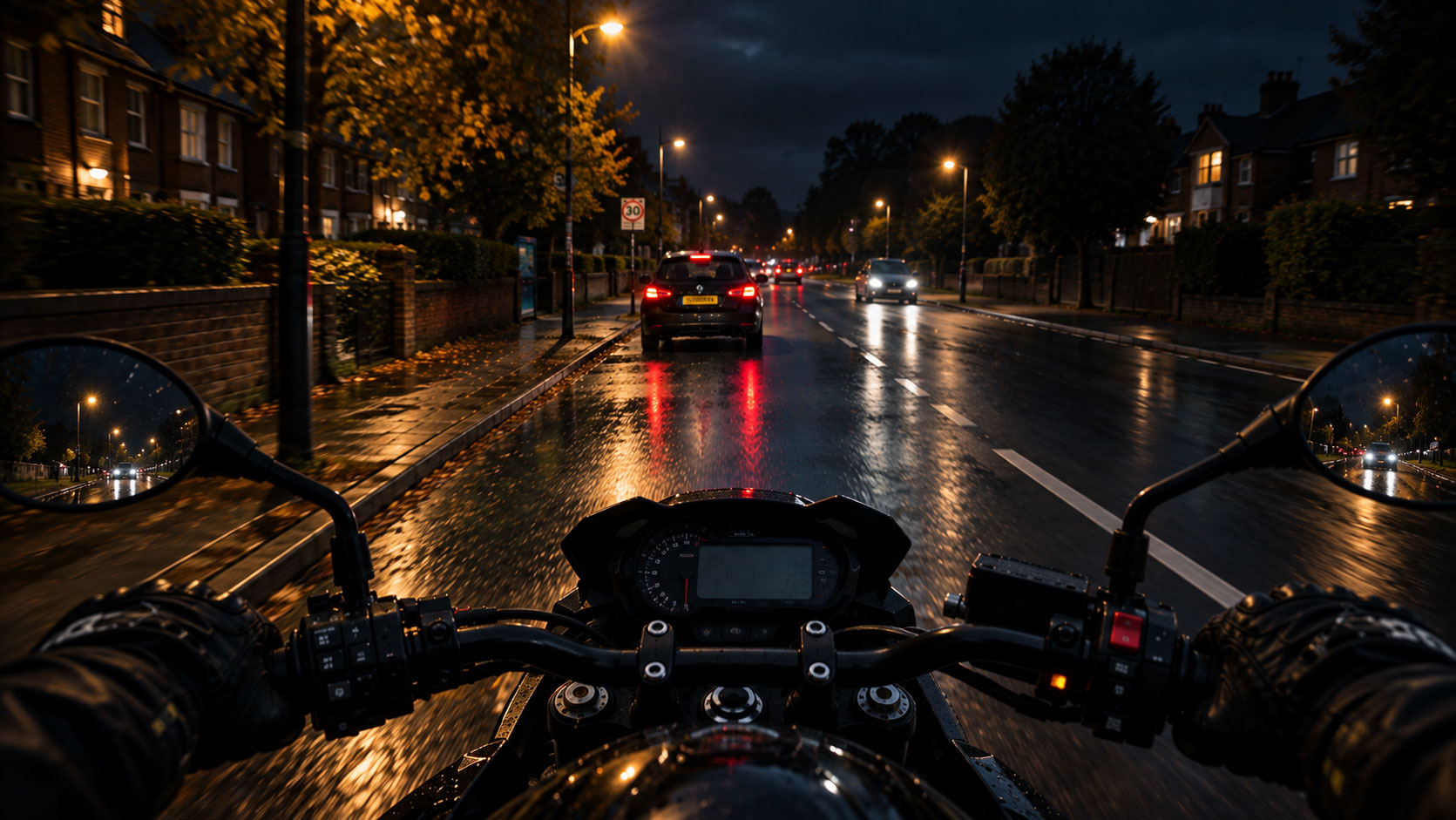
After dark
Night riding: visibility, wildlife and fatigue when the sun goes down
15 September 2026
3 min readA headlight doesn't light up the road, it lights up a cone of it. Everything else, the verge, the junction ahead, the deer already stepping onto the tarmac, is guesswork until it's close enough to matter. Night riding doesn't add some exotic new hazard to the list. It just strips away the margin you'd normally have for dealing with the ones that were already there.
Observation failures are already the single biggest recorded factor in motorcyclist collisions: DfT's 2025 motorcyclist factsheet attributes "ineffective observation" to 41% of cases. That's the daylight baseline. After dark, the same problem gets harder from both directions: it's harder for drivers to pick you out of the background, and harder for you to read what's happening beyond your own beam.
Visibility
Being seen, and being able to see
In daylight your outline, movement and headlight all help a driver's brain sort "motorcycle" from "background." At night your headlight can work against you: it's one bright point in a driver's peripheral vision, and it tells them almost nothing about your speed or distance. Ride where you'd be lit against the sky or oncoming traffic rather than tucked into the dark gap behind a car, and give yourself extra room at junctions where a driver is scanning for headlights, not motorcycles.
The other half of this is what you can and can't see. Depth cues that work fine in daylight (relative size, the way the road surface changes texture) mostly disappear at night, so judging the closing speed of an oncoming vehicle is genuinely harder, not just a case of paying more attention. Treat dipped beam as the default, and treat the edge of your beam as the edge of what you actually know about the road.
Wildlife
What's moving in the verges (and the high street)
Between 42,000 and 74,000 deer are involved in collisions on UK roads every year, causing around 20 human fatalities and hundreds of injuries, according to UKROEd. Two things make this a night-riding problem specifically: deer are most active at dawn and dusk, and the rutting season from October onwards makes them more mobile and less predictable. More than half of recorded strikes happen on faster roads, not just quiet country lanes, and it's not only a rural picture either. Muntjac deer in particular have adapted well to gardens, scrub and urban green space, and foxes are long-established across UK towns and cities, so a run through a town centre or suburban ring road isn't automatically wildlife-free.
If you see one deer, assume there are more nearby. A hard swerve at speed is usually worse for you than the animal is: covering the brakes and controlling the stop keeps the bike upright, which is the outcome that actually protects you.
Fatigue
The tired stretch home
Fatigue is a contributory factor in up to 20% of all road collisions, and up to a quarter of fatal and serious ones, per RoSPA's driver fatigue factsheet. Crashes caused by tiredness are around 50% more likely to be fatal or serious, largely because a tired rider often doesn't brake or steer away at all. Risk peaks between midnight and 6am, with a smaller dip in alertness between 2pm and 4pm.
The fix isn't caffeine or fresh air, both are short-term at best. It's building a proper stop into a long ride before you need one, not after.
The dark doesn't create new hazards. It just removes your margin for spotting the ones that were already there.
The essentials
None of this needs a change of gear, just a shift in what you're watching for. Here's what to keep front of mind:
Position yourself so you're visible against the sky or oncoming traffic, not lost in a car's shadow
Ease off through dawn and dusk wherever there's tree cover, scrub or a deer warning sign, town centres included
Build a proper stop into any ride longer than a couple of hours, especially between midnight and 6am
Don't rely on speed to get through the dark quicker: your stopping distance doesn't change, your reaction time does
Don't swerve hard for an animal in the road: a controlled brake keeps the bike under you
Think about whether the ride home after a long day is worth it, or whether it can wait until morning
The One Split Second take
None of this is about avoiding night rides. It's about knowing what changes when the sun goes down: what other road users can actually see of you, what's about to step out of the verge, and whether your own attention is still where it needs to be. Manage those three things and the dark stops being the problem, it's just less light.
Ride Safe.
“One split second of poor visibility, one animal you didn't expect, one gap in concentration. That's all it takes.”
We want your rider stories to help others learn.
Drop us an email at: