
Road awareness
One second: how far does your bike actually travel?
7 July 2026
3 min readName the site "One Split Second" and sooner or later someone asks the obvious question: how far is that, actually? The answer, at any real riding speed, is further than most people guess — and it's the gap between a near miss and a headline.
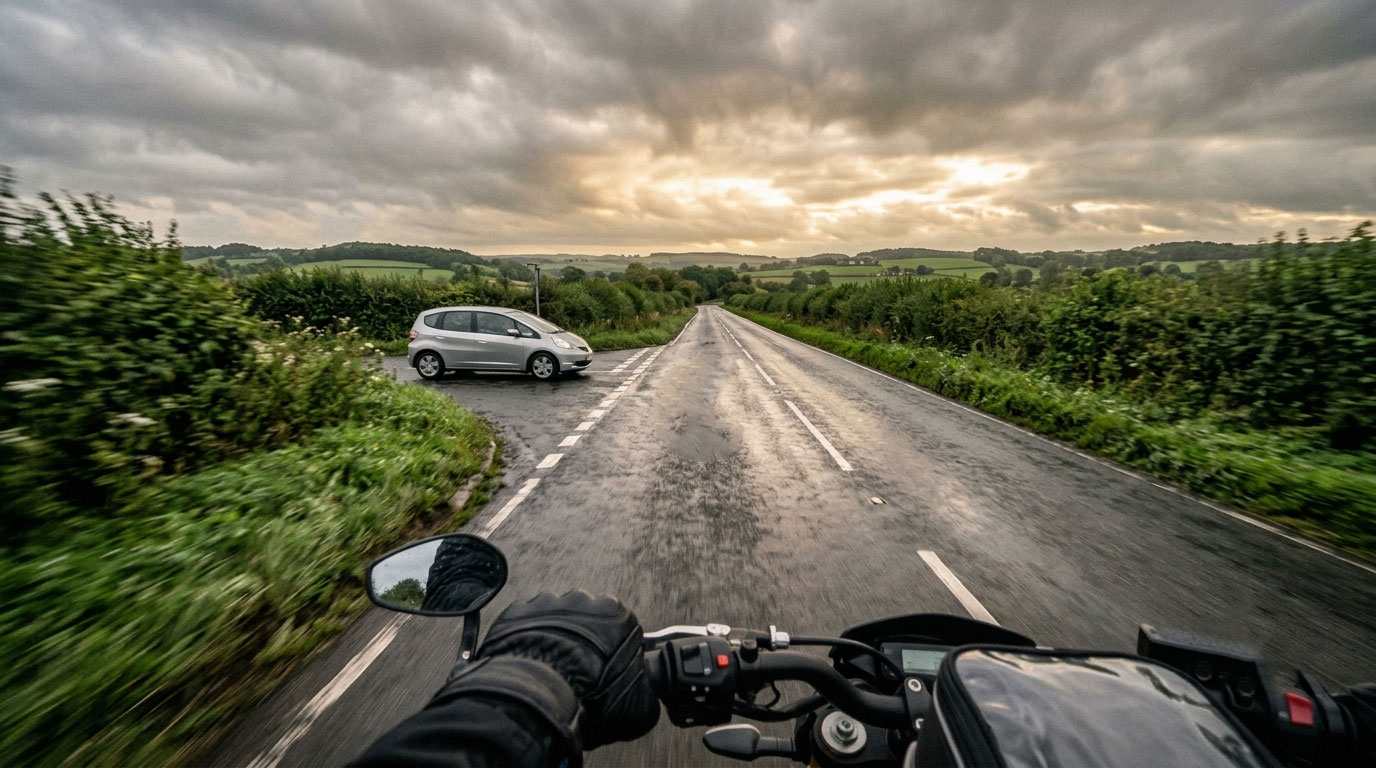
A second doesn't feel like much when you're counting it. On a bike, it's metres of tarmac disappearing under your wheels before your brain has even finished processing what it just saw.
The numbers
What one second looks like at speed
30 mph — urban roads
13.4 metres. About 44 feet. That's roughly the length of three transit vans, nose to tail, in the time it takes to blink and glance at your mirror. On a residential street, that's the gap between spotting a car door opening and being level with it.
60 mph — national speed limit
26.8 metres. Almost 88 feet — two and a half double-decker buses, covered in a single second. At this speed, a driver pulling out from a junction 30 metres away has given you barely more than a second to do something about it.
70 mph — motorway
31.3 metres. Just over 103 feet. That's nearly three double-decker buses, nose to tail, covered in a single second. At motorway speeds, that's how much distance can close between you and traffic ahead in the time it takes to notice something's changed.
Quick reference: distance per second
20 mph
9 m (29 ft) - Two car lengths
30 mph
13.4 m (44 ft) -Three car lengths
40 mph
17.9 m (59 ft) - Four car lengths
50 mph
22.4 m (73 ft) - Five car lengths
60 mph
26.8 m (88 ft) - Two and a half double-decker buses
70 mph
31.3 m (103 ft) - Nearly three double-decker buses
Reaction time
Why this isn't just trivia
The Highway Code's stopping distances are built on an assumed reaction time of around two-thirds of a second to a second, before you've even touched the brake. At 60 mph, that's 18 to 27 metres covered while you're still reacting — not braking, just reacting.
Add your actual braking distance on top, and the numbers most riders carry in their head — "I'll have time to stop" — usually fall well short of reality. Wet roads, worn tyres, and a moment's distraction only push that further.
This is the entire premise behind One Split Second. The margin between control and consequence is rarely more than a second or two. Knowing what that second costs you in distance is the first step to riding with it in mind — leaving more space, reading the road further ahead, and never assuming you have more time than you do.
The One Split Second take
You can't get a second back once it's gone, and at speed, it's already metres behind you. The riders who stay safest aren't the ones with the fastest reactions — they're the ones who never need them, because they left themselves the distance in the first place.
Ride Safe.
We want your rider stories to help others learn.
Drop us an Email at: