
Reading the road
Over, under, through: how to see the road before it shows itself
11 September 2026
4 min readMost riders think observation means looking further down the road. It's a start, but it's not the whole skill. The riders who never seem to get caught out aren't just looking further. They're looking differently. They're using the vehicle in front, the one behind it, and everything around them as a set of windows onto the hazard that hasn't happened yet.
It matters because when something does go wrong out there, it's rarely a mystery. The Department for Transport's motorcyclist casualty factsheet names "ineffective observation" (by the rider, the driver, or both) as the single most common contributory factor in fatal and serious collisions involving motorcyclists. Not speed. Not the machine. Looking, and not seeing what was already there to be seen.
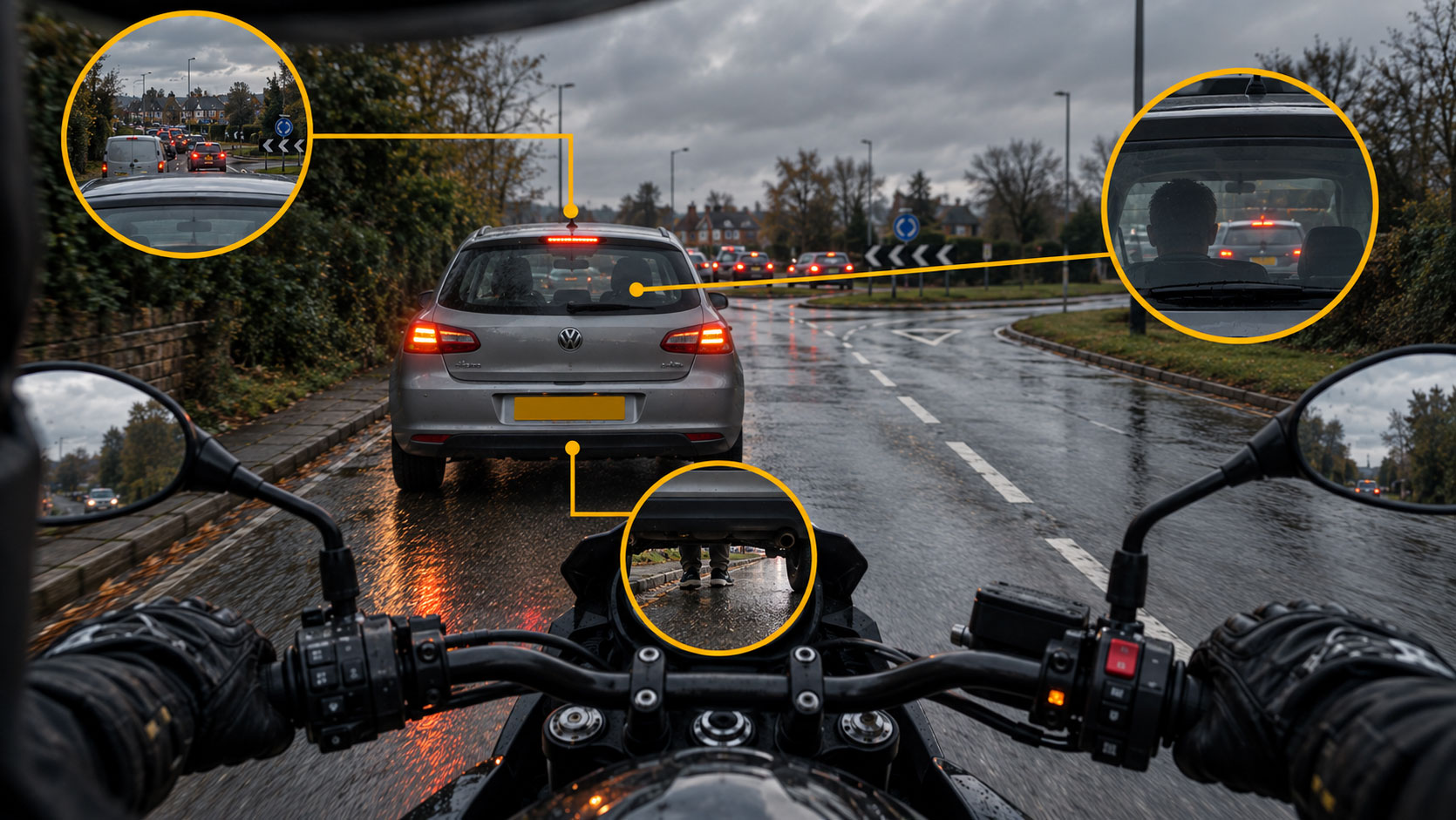
"Over, under, through" is a way of fixing that. It's a simple habit: instead of one flat view of the traffic ahead, you're constantly working three lines of sight through it.
Over: reading past the vehicle in front
The van in front of you is not the hazard. It's blocking your view of the hazard. Look over its roofline, past its mirrors, to the vanishing point and the vehicles beyond it. Brake lights two or three cars ahead of the one directly in front of you are your earliest warning that something is changing: a roundabout filling up, a queue forming, a pedestrian stepping into the carriageway.
By the time the vehicle immediately ahead of you reacts, you've already had the information for a second or two. That's not a small margin. At 30mph you cover roughly 13 metres a second. The gap between noticing early and noticing late is measured in bike lengths, not inches.
Under: the gap nobody thinks to check
Look under vehicles too: through the gap between the wheels and the road, and under wing mirrors and van bodies. It sounds unlikely to matter until you've used it to catch a pair of feet approaching a parked car, a dog on a lead, or a cyclist's wheel about to emerge from a junction hidden behind a bus. Movement shows under a vehicle before it shows around it, because the space is lower and often less cluttered than the view around the sides.
This is also where you catch the tell that a vehicle itself is about to move: a shadow shifting, a wheel starting to turn, a fraction before the vehicle's body language confirms it.
Through: windows in the traffic
Traffic is never as solid as it looks. There are gaps between vehicles, gaps at junction mouths, gaps through a windscreen and out the other side of the car in front. Learn to look through the car ahead of you: through its rear window, through the windscreen of the car ahead of that, rather than stopping your eyes at the nearest bit of bodywork. You'll pick up brake lights, indicators, and drivers' head movements you'd otherwise miss entirely.
Reflections do the same job. Shop windows, wet road surfaces, the glass on a bus shelter: all of them will show you a junction, a side road, or an approaching vehicle before you have a direct line of sight to it.
The gap in the traffic isn't empty. It's a window. Learn to look through it, not just at what's blocking it.
Let other traffic do some of the looking for you
Every vehicle around you is already reacting to things you can't yet see. A car slowing for no reason you can identify is reacting to something: a badly parked van, a pothole, a hidden give-way. A queue that suddenly stops rippling backwards tells you a gap has opened somewhere ahead. Even a driver's head turning at a junction is information: they've seen you, or they haven't, and either way you now know something you didn't a second ago.
Their bodywork is telling you things too. Light and movement travel down a car's paintwork, along a van's side panels, across a lorry's tank, the same way it moves across water. Watch it rather than just the vehicle's outline. A flicker running down the flank of the car ahead can tell you something's approaching from a side road or from behind, before you've got a direct line of sight to it yourself.
Treat other road users as sensors, not just obstacles. Read what they're doing, and what's playing out across them, not only where they are.
Building the habit
None of this needs to be conscious effort forever. Like counting your gears or checking your mirrors, over-under-through becomes a rolling scan you run without thinking about it: over the roofline, under the chassis, through the windows, on a loop, all the way down the road. The first few rides you deliberately practise it will feel slow. Within a few weeks it's just how you see.
Pick a vanishing point and keep re-reading it as the road curves and traffic moves
Scan over, under, and through the vehicle ahead as a continuous habit, not a one-off glance
Watch brake lights two or three vehicles ahead, not just the one in front
Use shop windows, wet tarmac, and vehicle glass as free extra sightlines
Fix your eyes on the bumper directly ahead of you
Assume a gap in traffic is safe just because nothing is visible in it yet
Wait for a hazard to move before you react to it
Treat the vehicle in front as the end of your field of view rather than the start of it
What is the driver ahead of you reacting to, and could you see it too if you looked past them?
Why has that gap opened up, and who's about to fill it?
Would you see a pedestrian's feet, or a cyclist's wheel, under that parked van before they stepped out?
The One Split Second take
Every one of these techniques does the same job: it buys you time. Not minutes. Split seconds. But a split second of warning is very often the entire difference between a hazard you manage smoothly and one that becomes a headline statistic. Over, under, through isn't about riding scared or over-scanning yourself into a headache. It's about spending eyes you already have more usefully, on information that was there all along.
With special thanks to Pete from Wiltshire RoADAR for the idea for this blog post
Ride Safe.
We want your rider stories to help others learn.
Drop us an email at: