
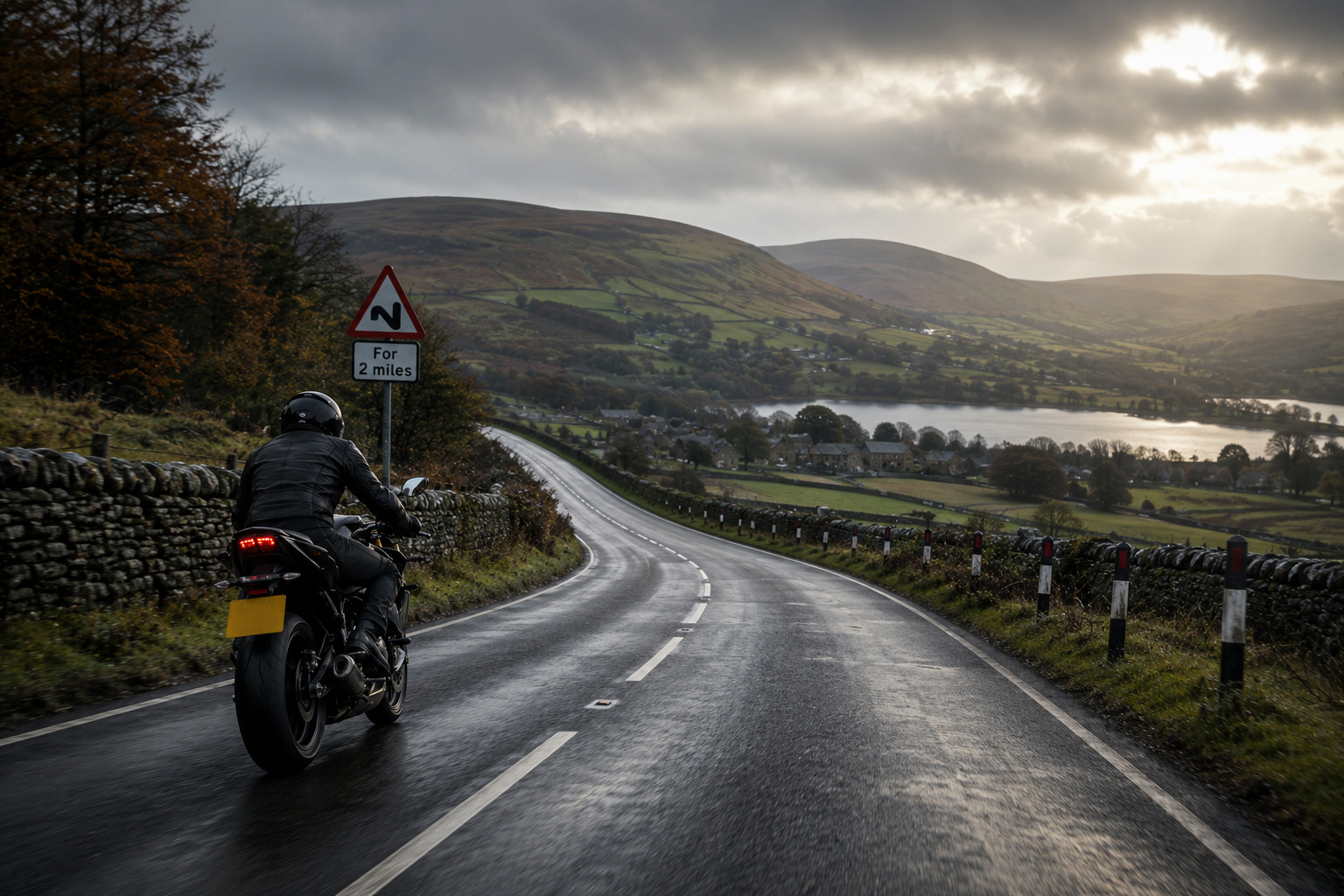
The Mind in the Saddle: The Psychology of Risk on Motorcycles
23 June 2026
5 min readThere is a common misconception among non-riders that anyone who swings a leg over a motorcycle must be an adrenaline junkie with a death wish. But ask any seasoned rider why they ride, and you’ll rarely hear about a craving for danger. Instead, you’ll hear about focus, freedom, and the sublime mental clarity that comes from being entirely locked into the present moment.
When you ride, the constant background noise of daily life falls away. Your brain enters a state of high-alert flow. Yet, the very psychological traits that make motorcycling so deeply rewarding can also warp how we perceive and manage risk on the road. Understanding the psychology of risk isn’t about sitting through a lecture; it’s about recognising how our own brains can trick us when we least expect it.
Because on a motorcycle, it only ever takes one split second for a psychological blind spot to become a life-altering reality.
1. The "Reckless Rider" Myth and Optimism Bias
When we read about a motorcycle collision in the news or scroll past a crash video online, our brain goes to work trying to protect our ego. We instinctively look for a reason to distance ourselves from the victim. “They must have been speeding,” we think, or “They were probably filtering like an idiot.”
This is known as Optimism Bias, the deep-rooted human belief that negative events are more likely to happen to others than to ourselves. It allows us to compartmentalise danger. We convince ourselves that crashes only happen to reckless riders, freeing us from the discomfort of acknowledging our own vulnerability.
But Department for Transport statistics tell a very different story. The vast majority of riders involved in serious incidents aren't acting like stunt drivers; they are ordinary commuters, weekend tourers, and experienced riders caught out by a subtle observation failure, a sudden patch of diesel, or an unexpected vehicle pull-out. When we let optimism bias dictate our mindset, we drop our guard. The moment you believe you are too good, too experienced, or too smart to crash is the exact moment your margin for error disappears.
2. Risk Compensation: The Paradox of Protection
Think about how you feel when you’re wearing your full, top-tier protective kit, CE-approved armor, premium leather or technical mesh, a five-star SHARP-rated helmet, and perhaps an airbag vest. You feel buttoned up, secure, and ready for anything.
Paradoxically, behavioural psychologists have found that as a human being's environment becomes safer or feels safer, their behaviour often changes to maintain a constant level of perceived risk. This is called Risk Compensation.
On a bike, this manifests subtly. When you are wearing flawless gear on a dry, sunny Sunday morning, your brain tells you that your safety net is massive. As a result, you might lean a little deeper into a blind bend, follow the car ahead a little closer, or delay your braking point just a fraction. Excellent protective gear is vital, but it is there to mitigate the consequences of a crash, it does not change the physical laws of grip, tarmac, or vehicle momentum. Your armor shouldn't be used as credit to buy higher speeds or lazier observations.
3. Familiarity Breeds Inattention
We are statistically at a much higher risk of having a momentary lapse on roads we ride every single day. When you commute along the same stretch of UK blacktop day in and day out, your brain shifts into a psychological efficiency mode called Automaticity.
Because you know exactly where the potholes are, where the road bends, and where the traffic usually builds, your subconscious starts filling in the blanks. You stop actively looking at the road and start relying on your mental map of what the road usually looks like.
But a road is a dynamic, living environment. The local junction that has been clear every morning for three years can, in a single split second, contain a spilled tank of diesel, a stranded delivery van, or a driver who simply hasn’t looked properly. True roadcraft means treating every familiar corner with the same hyper-vigilant scanning you would use on a completely unknown mountain pass.
4. Pack Mentality and the Ingress of Ego
Nowhere does motorcycle psychology shift faster than when we ride in a group. Rolling with your mates down a sweeping A-road feels incredible, but group dynamics introduce a powerful cocktail of peer pressure and social compliance.
When the rider at the front of the pack accelerates into an overtake, a subtle psychological countdown begins in the minds of the riders behind them. Nobody wants to be the one left behind, and nobody wants to look like they lack the skill to keep up. This pressure can cause less experienced or returning riders to override their own comfort zones, blindly following an overtake or carrying too much speed into a curve without checking their own line of sight.
Advanced riding isn't about showing off mechanical speed; it’s about possessing the psychological maturity to ride your own ride, manage your own space, and leave your ego parked firmly at the side of the road.
The One Split Second Take
Managing risk on a motorcycle isn't about riding in a state of constant, paralyzing fear. Fear makes you stiff, slows your reactions, and ruins the joy of the ride. Instead, safety comes from clarity and deliberate intent.
By understanding how your brain attempts to cut corners, whether through optimism bias, risk compensation, or group pressure, you can consciously step in and choose a better path.
Next time you head out:
Catch yourself if you assume a hazard "won't happen to you".
Remind yourself that your high-end kit doesn't give you extra grip on a greasy road.
Force your eyes to actively scan your daily commute as if you’ve never seen those roads before.
Ride at your own pace, every single time, regardless of who is in front of or behind you.
Our brains are highly sophisticated tools, but they are prone to taking shortcuts. On a motorcycle, those shortcuts can cost us everything. Keep it calm, build sharper habits, make calmer choices, and protect your mind so it can protect your life.
Have you ever caught your own brain playing tricks on you during a ride? Did a moment of overconfidence give you a near-miss that changed how you approach risk?
Ride Safe.
We want your rider stories to help others learn.
Drop us an Email at: