
Autumn riding
The road that changes under you
14 September 2026
4 min readNothing about the road has moved since summer. The tarmac's in the same place, the same bends still open the same way. But the ride has changed anyway, and the changes are the kind that catch experienced riders out precisely because nothing looks different until it's too late to react.
Autumn doesn't announce itself the way winter does. There's no ice warning on the forecast, no grit lorry out at 5am. Instead it's a hundred small shifts happening at once: less daylight, lower sun, wet leaves, standing water where there wasn't any in July. Individually, none of them is dramatic. Together, they mean the grip, visibility and judgement calls you relied on all summer are all quietly moving targets. The Department for Transport's motorcyclist casualty factsheet records an average of seven motorcyclist deaths and 104 serious injuries a week across Great Britain in recent years. Autumn is where a lot of that risk quietly compounds.
The light is working against you
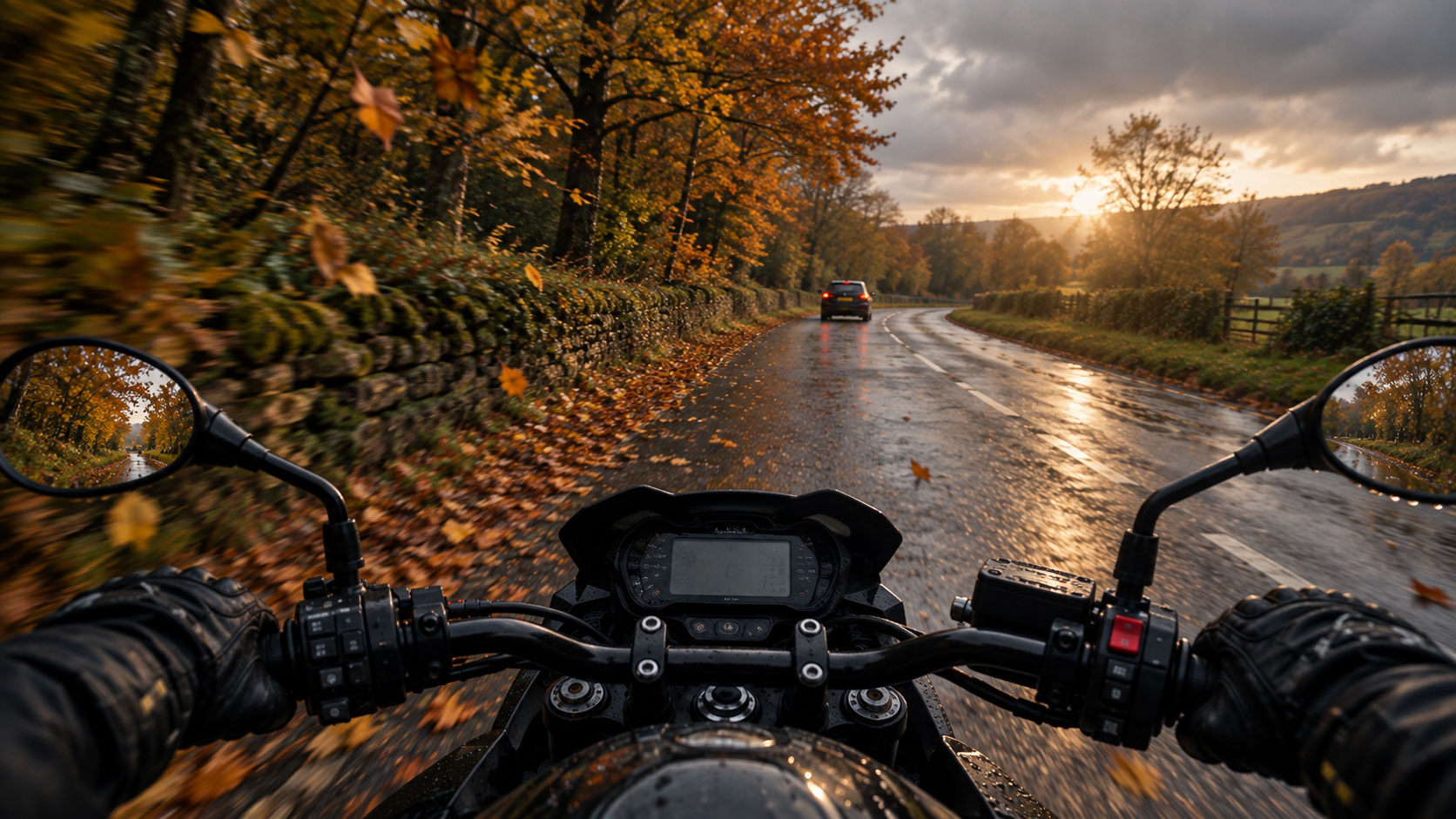
The clocks haven't gone back yet, but the sun's already sitting lower for longer. That golden low-angle light everyone photographs is also, for a rider, a visor full of glare at exactly the height most drivers' eye-lines sit. It flattens the road surface, hides the wet patch and the pothole in the same wash of brightness, and makes you far harder to see coming out of a side junction.
Once the clocks do change, the evening commute drops into darkness overnight. Telematics data analysed by insurer Insurethebox found accident rates for drivers between 5pm and 8pm rose by roughly a third in the weeks following the October clock change, with male drivers seeing the sharper increase. Riders are folded into that same commuting traffic, at the same junctions, at the same time of day, right as everyone else is recalibrating to driving home in the dark again.
Autumn also works against the one piece of kit riders lean on to be seen: high-vis. Fluorescent yellow and orange are chosen to stand out against green hedgerows and grey tarmac, but for a few weeks a year the verges themselves turn gold, orange and red. Against a backdrop the same colour as your jacket, that contrast advantage narrows right when the light is already working against you. It's worth a read on how much colour choice depends on background, this piece on the psychology behind rider visibility and gear colour makes the same point about matching gear to your surroundings rather than assuming one colour works everywhere, year-round.
Grip is no longer a constant
Wet leaves aren't just slippery, they're unpredictable. A leaf mat can sit on the road holding moisture underneath it long after the rest of the surface has dried, so the same corner can catch you on a day that looks dry. They're worst exactly where riders need grip most: the apex of a bend, under trees, on the shaded side of a lane the sun never quite reaches this time of year.
Standing water builds the same way. Drains clogged with the season's first leaf fall don't clear the water they used to, so puddles collect in places you've ridden through cleanly all summer. The Highway Code's guidance on stopping distances is blunt about it: on a wet road, at least double the gap you'd leave in the dry. That's not a seasonal suggestion, it's the physics of a road that's stopped behaving the way it did in August.
The corner hasn't changed. What's sitting on it has.
Temperature swings catch tyres cold
Autumn mornings can start a good ten degrees colder than the afternoon that follows. Tyres take longer to reach working temperature in that cold, and a lot of riders don't adjust their first few miles to account for it. The first roundabout of the day, on tyres that are still cold from a garage overnight, is a different proposition to the same roundabout at 2pm.
What to change, not just what to notice
None of this means riding less, it means riding differently for a season that's genuinely different underneath you.
Build in a few extra minutes at the start of every ride to let tyres and yourself warm up before pushing on
Treat any shaded, tree-lined stretch as if it's wet, even when the rest of the road looks dry
Increase your following distance as standard once the leaves are down, not just when you can see them
Check your visor and lights are properly clean before a low-sun commute, glare finds every smear
Reconsider your hi-vis against the backdrop it'll actually be seen on, gold and orange gear can disappear into autumn foliage the way it never would against summer green
Don't assume a corner is the same corner it was in July just because the surface looks dry
Don't brake or accelerate hard over visible leaf litter or drain covers, even at low speed
Think about swapping your ride time where you can, riding either side of the low-sun and rush-hour windows removes two hazards at once
The One Split Second take
Every one of these hazards is small on its own. A slightly lower sun. A slightly colder tyre. A patch of leaves that's been there for two days. None of it is dramatic enough to make the news, and that's exactly the problem: nothing forces you to notice the road has changed, so most riders don't, until the one split second it matters.
The riders who get through autumn cleanly aren't the ones who ride slower out of caution. They're the ones who've updated their picture of the road to match the season it's actually in.
Ride Safe.
The conditions changed weeks ago. Has your riding?
We want your rider stories to help others learn.
Drop us an email at: