
Why Speed Isn't Always the Problem
16 June 2026
3 min readWhen a motorcycle collision makes the news, one assumption often follows: "The rider must have been speeding."
Sometimes that's true. Excessive speed can reduce reaction time, increase stopping distances and make even a small mistake far more serious.
But the reality is more complicated.
Many motorcycle accidents happen at or below the speed limit. In those cases, the issue isn't necessarily speed itself—it's timing, positioning, observation, or another road user making an unexpected decision.
The Difference Between Speed and Excessive Speed
Speed limits are just that: limits. They are not targets.
You can be travelling at 60 mph on a national speed limit road and still be riding too fast for the conditions. Equally, you could be riding at 30 mph in heavy traffic and still be putting yourself at risk if you're not paying attention.
Safe riding is about choosing a speed that matches what you can see and what you can reasonably expect to happen next.
Ask yourself:
Can I stop safely in the distance I can see to be clear?
Am I approaching a hidden junction?
Is there a bend I can't see through?
Could someone pull out in front of me?
If the answer raises any doubt, easing off the throttle is never a bad decision.
Observation Saves More Than Braking
Imagine riding through a village at exactly 30 mph.
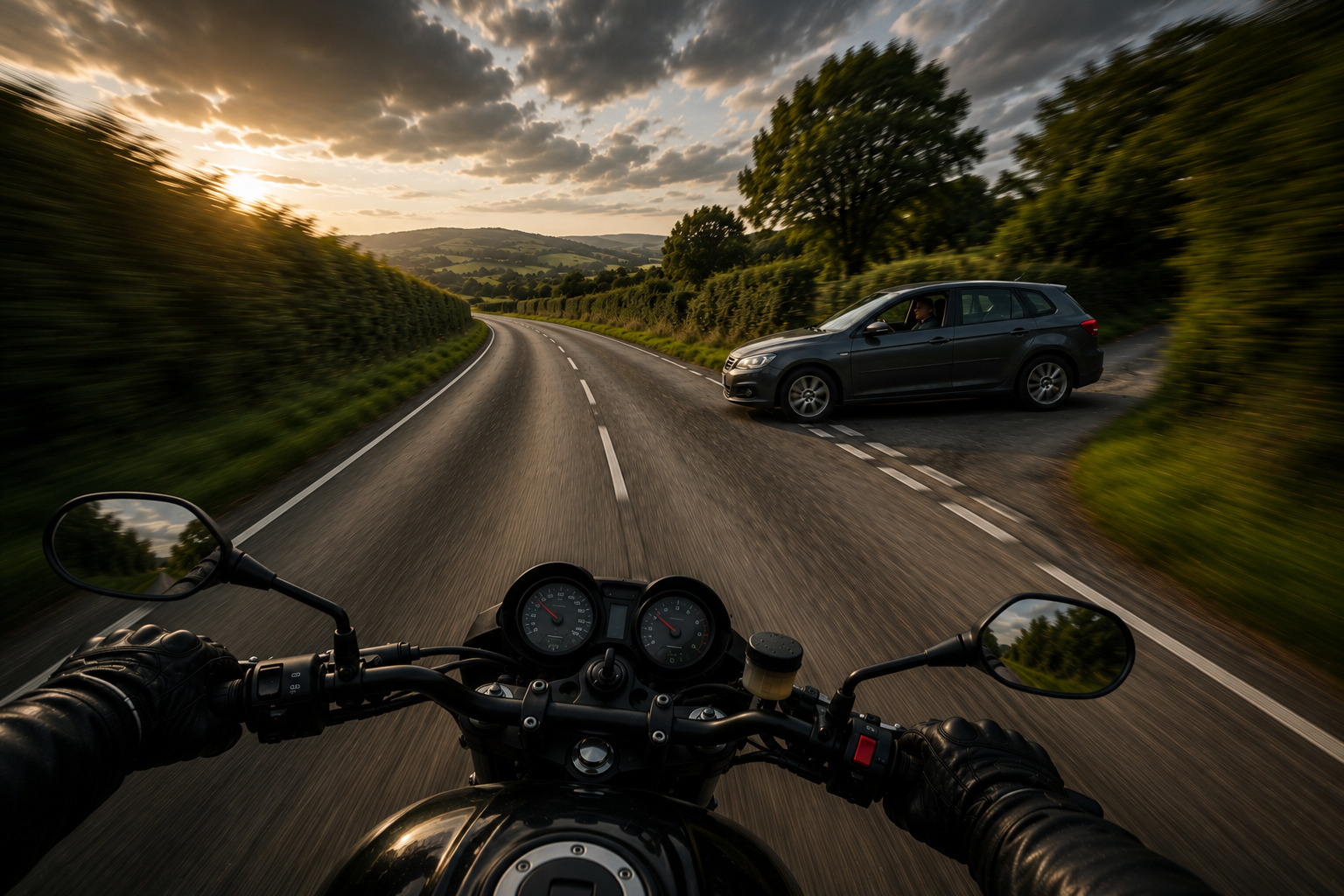
A van is parked on the left, partially blocking a side road. A car begins to edge forward from behind it.
You're within the speed limit, but if you're not actively scanning for hazards, you may still have very little time to react.
Now imagine approaching the same situation at 25 mph while already covering the brakes and anticipating movement.
That small reduction in speed—and the increase in awareness—could make all the difference.
The Hidden Risks
Many serious incidents involve factors such as:
Drivers pulling out from junctions.
Failed observations by other road users.
Overtaking in unsuitable places.
Poor road surfaces or diesel spills.
Misjudging a bend.
Target fixation.
Fatigue or distraction.
Riding beyond visibility or weather conditions.
None of these necessarily involve breaking the speed limit, but they all require good judgement.
Riding to the Conditions
Experienced riders often talk about "making progress", but making progress doesn't mean riding fast.
It means riding smoothly, planning ahead, reading the road and keeping options open.
On a wet road with poor visibility, the safest speed might be well below the posted limit.
On an empty, dry road with excellent visibility, the limit may still not be appropriate if there's a hidden entrance, livestock nearby or loose gravel around the next bend.
The best riders don't chase the speed limit—they ride to what the road is telling them.
It's About Decisions
At One Split Second, we believe many incidents come down to a chain of small decisions rather than one dramatic mistake.
Choosing to leave a bigger gap.
Rolling off the throttle before a blind bend.
Waiting a few seconds before overtaking.
Expecting that car at the junction not to see you.
These choices may seem insignificant in the moment, but they can prevent a collision before it ever develops.
The Takeaway
Speed certainly plays a role in many motorcycle crashes, and riding too fast for the road or conditions can have devastating consequences.
But speed isn't always the root cause.
Observation, anticipation, positioning, attitude and decision-making are just as important—and often they're the factors that keep a rider out of trouble in the first place.
The safest riders aren't always the slowest.
They're the ones who are thinking ahead.
Because in the end, it's often not just about how fast you're going.
It's about what you do in that one split second when everything changes.
Ride Safe.