
Roundabouts
Multi-lane roundabouts: the junction that plays by its own rules
12 August 2026
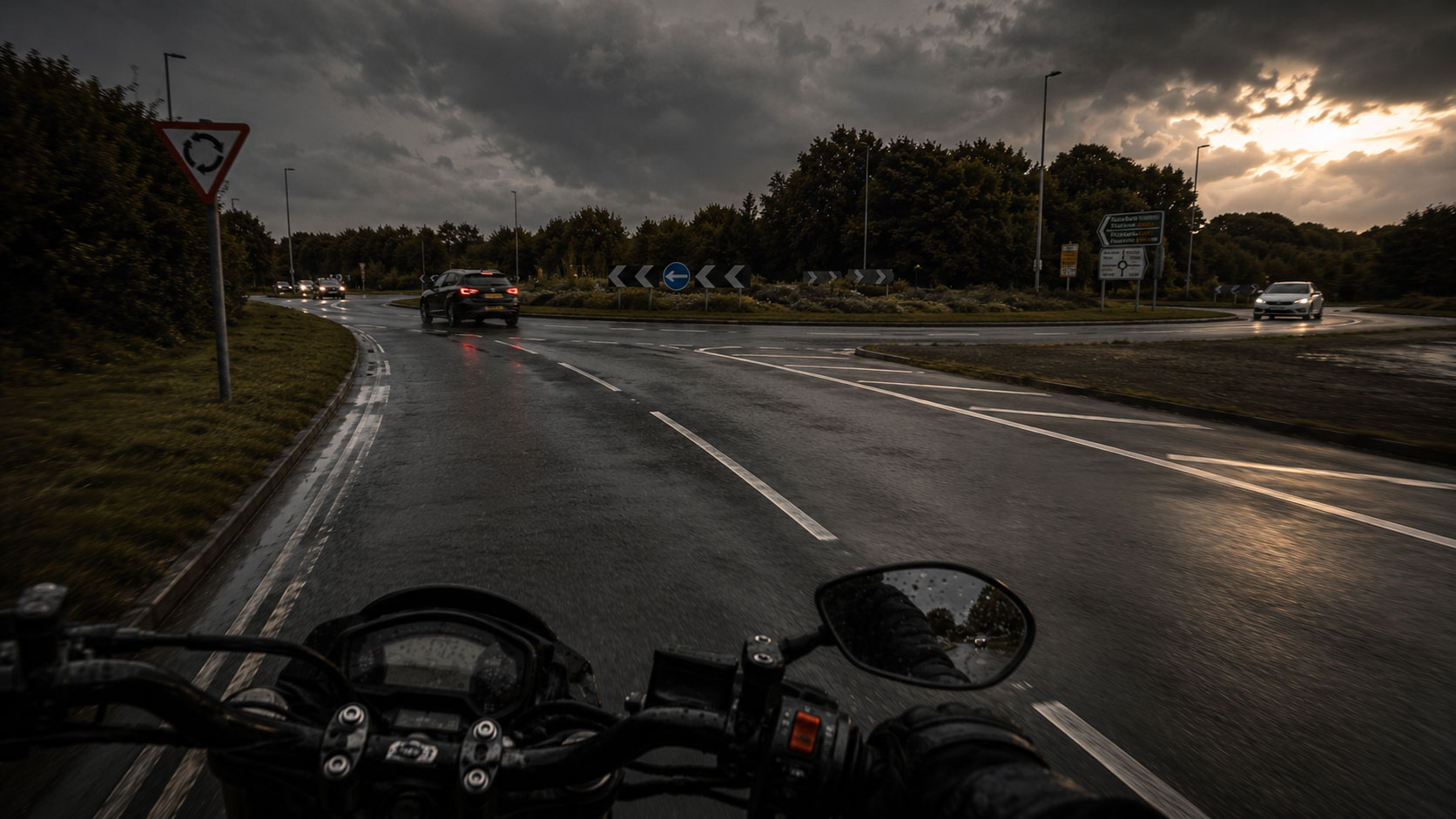
4 min readAsk a rider to name their least favourite piece of road and plenty won't say a blind bend or a wet roundabout in the countryside — they'll say a big multi-lane roundabout on the edge of town. Three lanes, four exits, a bus committing to a line it clearly can't hold, and a queue of drivers all making slightly different decisions at the same time.
Roundabouts don't kill riders as often as T-junctions do. According to the Department for Transport's motorcyclist casualty data, roundabouts account for around 3% of motorcyclist fatalities — but a disproportionate 8% of serious injuries. Read that carefully: roundabouts are rarely where riders die, but they're exactly where riders come off. Lower speeds mean lower severity, not lower risk. And a multi-lane roundabout brings problems a simple junction never has to deal with.
That's why this one gets its own piece. Everything in our junctions article still applies — but multi-lane roundabouts add layers of complexity that deserve to be unpacked properly.
The mechanics
Why a multi-lane roundabout isn't just a bigger junction
A standard junction gives you one decision point and one vehicle to read. A multi-lane roundabout gives you several vehicles, in several lanes, all making independent decisions about speed, gap, and exit — and you're often trying to read all of it while leaned over and committing to a lane of your own.
Add a lorry or a bus to the mix and the geometry changes again. Long vehicles frequently can't hold a single lane around a roundabout; they need the width of two lanes to get their trailer round without mounting the kerb or clipping the inside line. A rider sitting where the Highway Code "should" put them can find a 44-tonne artic sweeping directly across their lane on the exit.
Where it goes wrong
The mistakes that catch riders out
A few patterns come up again and again on multi-lane roundabouts:
Late lane decisions
Committing to a lane at the very last second, then trying to correct it mid-roundabout — exactly when you should be at your smoothest and most predictable.
Riding the white lines
Sitting on or straddling the lane markings to keep options open. Those lines are painted thermoplastic, and thermoplastic gets slippery, especially when damp — the worst possible surface to be leaned over on.
Trusting an indicator
A flashing indicator tells you what a driver says they intend to do, not what they're about to do. Drivers routinely signal late, signal the wrong exit, or don't signal at all.
Losing the entry point
Focusing on the vehicle directly ahead and missing a car entering from the left, three-quarters of the way round — a classic SMIDSY moment, made worse by a multi-lane roundabout's extra entry points.
Following a large vehicle too closely
Sitting in a lorry or bus's blind spot as it sweeps across your lane on the way to its exit.
“On a single junction, you're reading one decision. On a multi-lane roundabout, you're reading everyone's decision, all at once — and still making your own.”
Lane discipline
Pick your lane before you arrive, not on it
The single biggest improvement most riders can make on multi-lane roundabouts is deciding their lane and their exit before they reach the give-way line — not while they're going round. Look at the roundabout layout as you approach: lane arrows, signs, and the general flow of traffic tell you which lane you need well before you're committed to it.
Once you're on the roundabout, hold your line through the arc rather than tightening or drifting across it. Riders who cut across lanes mid-roundabout to "straighten the corner" put themselves directly in the path of vehicles who assumed they'd stay put.
Roundabout approach checklist
What to run through on approach
Identify your exit and lane before the give-way line
not once you're already on the roundabout
Check for large vehicles already on the roundabout
plan for the width they'll need to swing wide
Scan every entry point on your way round
not just the vehicle ahead of you
Cover your brakes on the approach
traffic on roundabouts changes speed constantly
Keep your line through the arc of your lane
smooth and predictable beats fast and reactive
Straddling or riding along the painted lane lines
especially in the wet
Assuming an indicator means a vehicle will actually take that exit
Sitting in a lorry or bus's blind spot as it sweeps across the roundabout
Changing lanes once you're already committed and moving through
Think: if that car three-quarters of the way round pulls out now, where do I have room to go?
On big rural or multi-exit roundabouts, know your exit is often "one more than you think"
count the exits, don't guess
The one split second take
Respect the roundabout, don't fear it
A multi-lane roundabout isn't more dangerous because it's inherently hostile — it's demanding because it asks you to process more information, from more directions, in less time than almost any other feature on a UK road. Riders who struggle with them are usually struggling with timing, not skill: deciding too late, committing too slowly, or trusting a signal instead of a driver's actual movement.
Decide early. Hold your lane. Watch every entry point, not just the vehicle in front. And give large vehicles the room their swing actually needs, not the room the road markings suggest they should need.
Ride Safe.
“A roundabout only has one hazard if you're lucky. Plan for all of them, and you'll be ready for whichever one shows up."”
We want your rider stories to help others learn.
Drop us an email at: